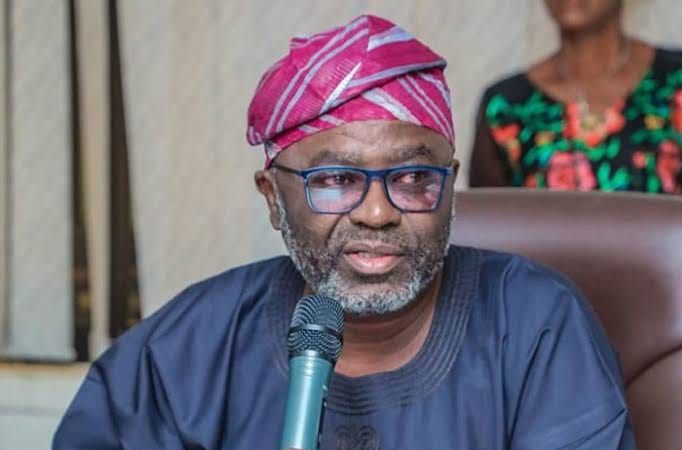
Gov. Abiodun Confident State Assemblies Will Simultaneously Pass State Police Bill

Ogun State Governor, Prince Dapo Abiodun, has expressed optimism that the 36 State Houses of Assembly will simultaneously approve the constitutional amendment bill seeking the establishment of State Police, describing the move as a major milestone in strengthening Nigeria’s internal security framework.
Governor Abiodun stated this during an Arise Television Town Hall Meeting on State Policing, where he noted that the creation of State Police has gained rare National consensus among political leaders and stakeholders across the Country.
The Governor commended President Bola Ahmed Tinubu for transmitting the Executive Bill on State Police to the National Assembly and praised lawmakers and other stakeholders for advancing the legislative process.
According to him, June 24, 2026, marked a historic moment in Nigeria’s democratic history as the Executive Bill on State Police was formally transmitted to the National Assembly and promptly considered by the Senate.
Abiodun noted that previous administrations had made unsuccessful attempts to establish State Police, making the current progress particularly significant.
“I want to thank Arise TV for organising this very important town hall meeting on a matter that has now become a National consensus. One of the few subjects in Nigeria that enjoys such broad National acceptance is the creation of State police,” he said.
The Governor, who chairs the Nigeria Governors’ Forum Committee on State Police Creation, disclosed that Governors across the federation played a critical role in shaping the proposed legislation, underscoring the importance sub-national Governments attach to the initiative.
He observed that despite being constitutionally recognised as Chief Security Officers of their States, Governors have historically exercised limited control over policing operations while shouldering substantial financial responsibilities in supporting security Agencies.
Abiodun revealed that the Nigeria Governors’ Forum established a committee comprising Governors and State Attorneys-General to work closely with the executive and Legislative Arms of Government in developing the bill.
“The bill has our input, and we are excited because what we are seeing today is the fulfilment of a dream we have nurtured for many years. It validates our long-standing advocacy for community policing,” he added.
The Governor also highlighted the achievements of regional security outfits, particularly the South-West Security Network, codenamed Amotekun, saying such organisations have successfully complemented conventional policing through intelligence gathering and community engagement.
He maintained that the establishment of State Police would significantly improve Nigeria’s police-to-citizen ratio and create thousands of jobs across the country’s 774 local government areas.
According to him, Nigeria currently has an estimated ratio of one Police Officer to about 660 citizens, compared with the United Nations recommendation of one Officer to 440 citizens and the global benchmark of one officer to 250 citizens.
Using Ogun State as an example, Abiodun said the State presently has about 6,000 personnel across Amotekun, the So-Safe Corps, vigilante groups and other security outfits. He added that similar structures in the 36 States could immediately provide between 300,000 and 400,000 additional security personnel Nationwide.
He explained that the constitutional amendment seeks to move policing from the Exclusive Legislative List to the Concurrent Legislative List, thereby granting States the constitutional authority to establish their own Police Services.
The Governor expressed confidence that, given the extensive consultations and active participation of Governors in drafting the bill, all State legislatures would consider and pass the amendment simultaneously once transmitted to them.
Looking beyond the constitutional amendment, Abiodun stressed that substantial work still lies ahead in operationalising the proposed state police system.
He noted that consequential amendments would be required to amend or repeal relevant provisions of the existing Police Act to align with the new constitutional framework.
He added that the next phase would involve developing operational structures for state police, including defining its organisational framework, relationship with the National Police, oversight mechanisms to prevent abuse, funding arrangements, training standards, and the establishment of institutions such as Police Councils and Police Service Commissions.
According to him, these measures are essential to ensuring that State Police operates effectively, professionally and in a manner that enhances security while safeguarding the rights of Nigerians.