

“Naija No Dey Carry Last”: King Charles Signals New Era in UK–Nigeria Relations at Windsor Banquet
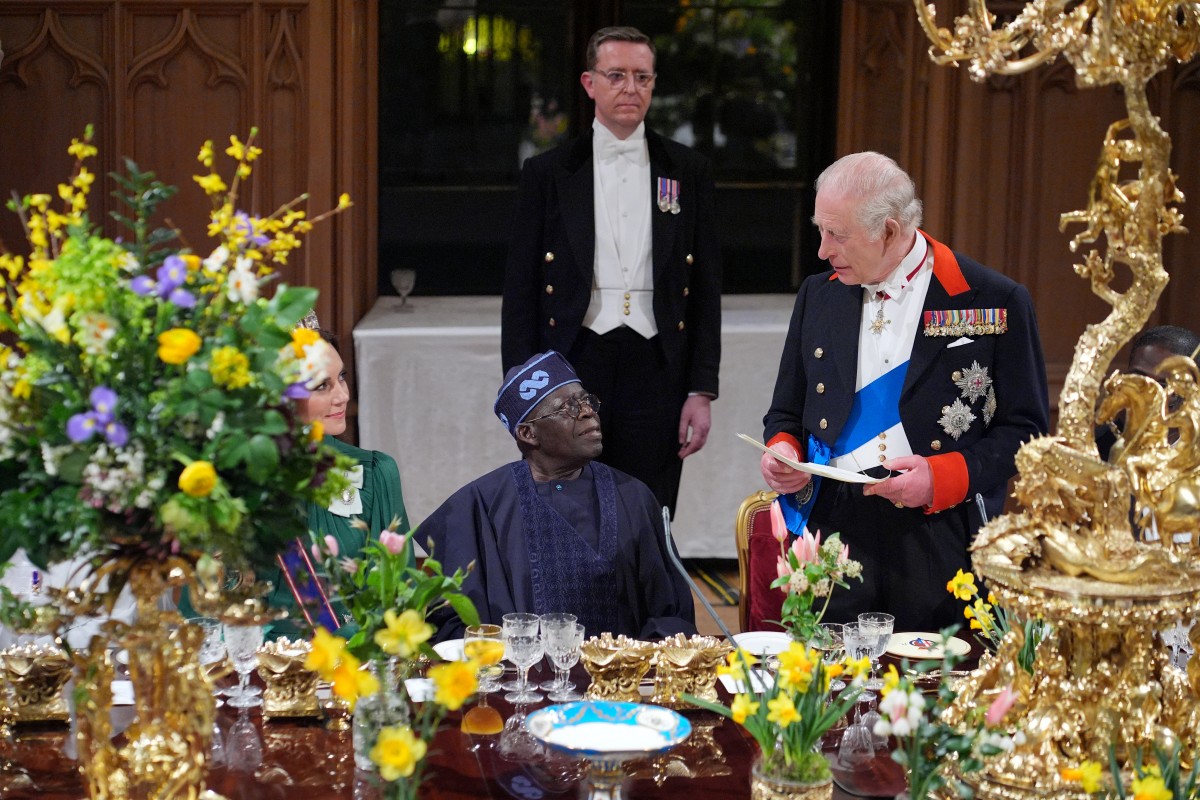
At an elaborate state banquet inside Windsor Castle, King Charles III delivered a speech that blended symbolism with strategy, using culture, commerce, and candid historical reflection to redefine Britain’s relationship with Bola Tinubu.
Global Mirror News gathered that the event, held in honour of President Tinubu and First Lady Oluremi Tinubu during a two-day state visit, went beyond ceremonial diplomacy.
It became a platform for the British monarch to acknowledge Nigeria’s growing global relevance while subtly advancing the United Kingdom’s economic and geopolitical interests.
From the outset, King Charles framed Nigeria not as a Nation in transition but as one that has fully “arrived.” Reflecting on his previous visits, including his 2018 trip, he described a Country of over 230 million people—remarkably youthful, with about half its population under 18 driven by energy, ingenuity, ambition, and a readiness to confront global challenges.
The remark positioned Nigeria as a future-facing power rather than a developing state still finding its footing.
The monarch’s speech leaned heavily on Nigeria’s cultural influence in Britain, highlighting how Afrobeats continues to dominate concert halls while Nollywood productions captivate audiences on screens across the UK.
He extended this recognition to Nigerians excelling in the English Premier League and even within Britain’s judicial system, reinforcing the idea that Nigerian contributions are deeply woven into the fabric of British society.
In a particularly symbolic moment, King Charles engaged with Nigeria’s identity on its own terms, quoting proverbs from Yoruba, Hausa, and Igbo traditions to emphasize shared wisdom and cooperation.
The Yoruba saying that “rain does not fall on one roof alone,” the Hausa reflection that “when the music changes, so does the dance,” and the Igbo belief that “two heads are better than one” were carefully selected to reinforce a message of collective progress and mutual dependence.
While the tone was largely celebratory, the monarch did not ignore the complexities of history. He acknowledged that the shared past between Britain and Nigeria contains painful chapters that cannot simply be erased with words.
However, rather than dwell on apology, he pivoted toward learning from that history as a basis for building a more constructive and balanced future. This approach reflected a broader diplomatic strategy—recognition without reopening old wounds in ways that could complicate present cooperation.
Economic relations featured prominently throughout the address, underscoring the practical motivations behind the warm rhetoric. King Charles pointed out that Nigeria has recently emerged as the United Kingdom’s largest export market in Africa, a milestone that signals shifting trade dynamics.
He spoke of Nigerian banks establishing a presence in London’s financial district, companies listing on the London Stock Exchange, and the steady expansion of technology partnerships between both Countries.
Tourism and people-to-people connections were also highlighted as key indicators of mutual engagement. The monarch noted that Nigerian visitors spent £178 million in Britain in 2024, while over 250,000 Britons traveled to Nigeria and spent a comparable amount, illustrating a balanced flow of economic and cultural exchange.
He added that the phrase “Made in UK,” long associated with quality in Nigeria, now carries what he described as a “distinctively Nigerian flavour,” hinting at the growing influence of Nigerian enterprise and taste.
Another notable dimension of the speech was the emphasis on Nigeria’s role as a model of interfaith coexistence. King Charles referenced his interaction with Christian and Muslim leaders earlier in the day, describing it as a powerful example of how different faith communities can live and work together in harmony.
In presenting Nigeria this way, he elevated the Country’s global image as not just a populous Nation, but one capable of offering lessons in unity amid diversity.
The Nigerian diaspora in the United Kingdom received special recognition as well. With more than half a million Nigerians and people of Nigerian heritage living in Britain, the King described them as a “living bridge” connecting both Nations.
He acknowledged their contributions across sectors including business, technology, academia, law, science, sports, literature, and public service, reinforcing the idea that the bilateral relationship is sustained not only by governments but by people.
Even lighter moments carried diplomatic weight. The King’s anecdote about hosting young Nigerians at a “Jollof and Tea” gathering at St. James’s Palace drew laughter as he playfully sidestepped the long-running debate over which Country makes the best Jollof rice.
His diplomatic neutrality—mentioning Nigeria, Ghana, and Senegal—was a reminder of the cultural sensitivities that often accompany even the most informal exchanges.
Ultimately, the defining line of the evening came as King Charles raised a toast and declared in Nigerian Pidgin, “Naija No Dey Carry Last.” The phrase, met with applause and smiles, encapsulated the broader message of the night: recognition of Nigeria’s rising stature and a deliberate effort by Britain to align itself with that trajectory.
Global Mirror News observes that the speech was a calculated blend of admiration and strategy, aimed at repositioning UK–Nigeria relations as a partnership of equals anchored in shared prosperity, cultural exchange, and forward-looking diplomacy.
Beneath the ceremonial grandeur, the message was unmistakable—Nigeria is no longer simply part of Britain’s historical narrative, but an essential partner in shaping its Global future.